Swiss-designed · Assembled in the USA · First U.S. systems available late 2026
Swiss-designed · Assembled in the USA

Beyond filtered.
Inspired by nature.

Since 2019, Swiss Water Systems has combined three-stage pre-filtration, high-grade reverse osmosis, activated-carbon pH balancing, and a Swiss-made structuring cylinder inspired by Hexagonal Water. Now coming to American homes.

Weite, SG Designed in Switzerland Since 2019 Founded in Switzerland Late 2026 First U.S. delivery 316L Food- & medical-grade steel Up to 99% Contaminants reduced resP Pure, structured permeate Weite, SG Designed in Switzerland Since 2019 Founded in Switzerland Late 2026 First U.S. delivery 316L Food- & medical-grade steel Up to 99% Contaminants reduced resP Pure, structured permeate
What modern water carries

Municipal treatment was built for a different century.

Public water systems do an honest job removing the things they were designed to remove. The challenge is to remove what they were not designed for.

Pharmaceutical residue

  • Hormones
  • Antidepressants
  • Painkillers
  • Antibiotics

Industrial & environmental

  • PFAS (forever chemicals)
  • Microplastics
  • Heavy metals
  • Pesticides & herbicides

Treatment byproducts

  • Chlorine derivatives
  • Disinfection byproducts
  • Pipeline corrosion
  • Biological matter
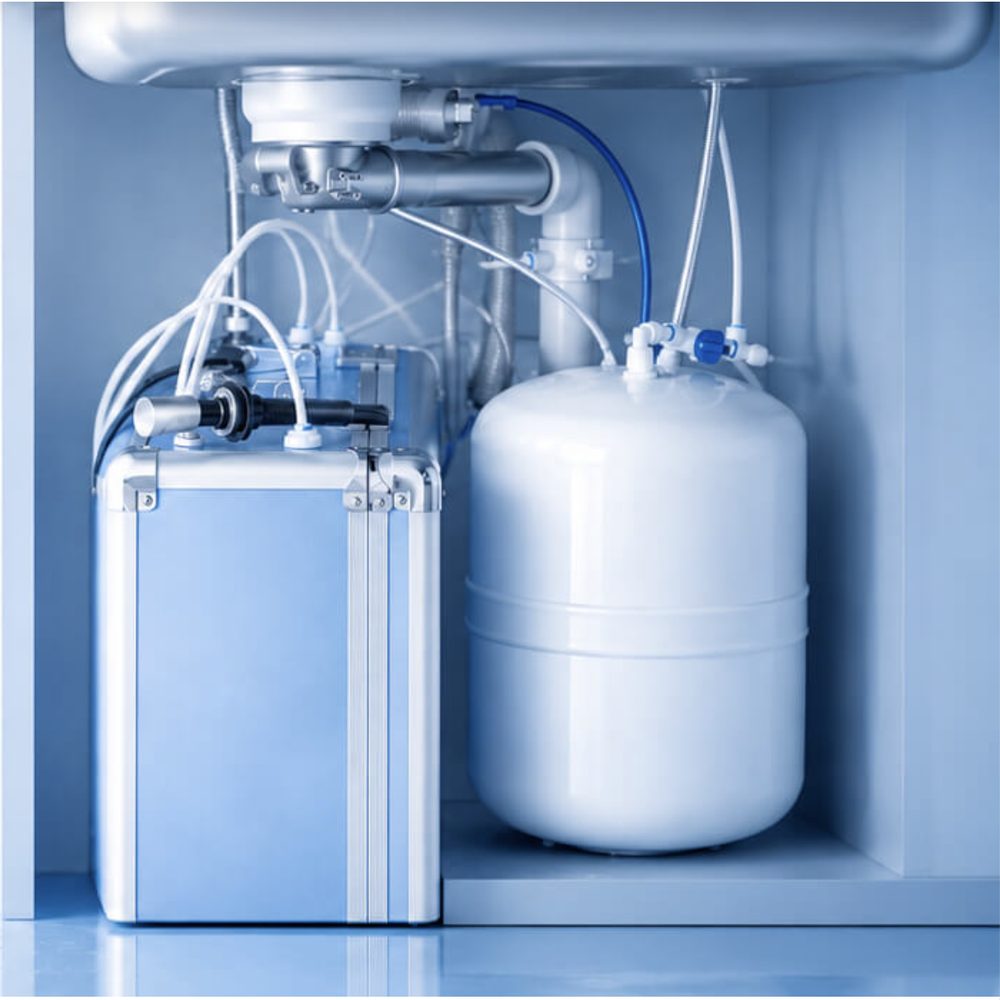
A Swiss Water Systems reverse-osmosis system installed under a kitchen sink
Engineered in Switzerland Assembled in the USA
The solution

One system, right at your faucet.

Everything modern water carries is dealt with at the source. A single Swiss Water system installs at your kitchen sink — three-stage pre-filtration, reverse osmosis, activated-carbon pH balancing, and a Swiss-made structuring cylinder — turning ordinary tap water into reverse-osmosis, pH-balanced drinking water.

See how it works
How it works

From your tap to resP.

Every system works in stages. First, three pre-filters trap coarse material down to about 0.01 µm — sediment, rust, and grit. Reverse osmosis then removes the far smaller molecules, making it the most thorough way to clean water. An activated carbon filter raises the slightly acidic water back to a neutral pH. Finally comes the step that makes Swiss Water its own: a Swiss-made structuring cylinder.

Tap water Pre-filtration 3 pre-filters Pb PFAS Cl Reverse osmosis 0.0001 µm · up to 99% Pb PFAS to drain — up to 99% removed pH pH balance activated carbon SWISS-MADE Structuring structuring cylinder resP

Hover or tap a stage in the diagram to see what it does — or open all four below.

Read all four stages
Stage One

Pre-filtration

The water passes through three pre-filters that retain coarse material down to roughly 0.01 µm — sediment, rust, and grit. This protects the membrane and extends the life of every stage that follows. The far smaller molecules, such as pesticide and pharmaceutical residues, are left for the reverse-osmosis membrane in the next stage.

Stage Two

Reverse osmosis

A high-grade molecular membrane retains dissolved contaminants down to roughly 0.0001 µm (0.1 nanometers): pharmaceutical residues, PFAS, microplastics, heavy metals, pesticides, chlorine byproducts, and biological matter. What passes through is essentially water alone. A timer-controlled automatic flushing system, developed by Swiss Water Systems, rinses the membrane regularly, reducing deposits and extending the life of every component.

Stage Three

pH after the membrane

The slightly acidic water after reverse osmosis is raised to the neutral pH range via an activated carbon filter. The physical structuring then follows.

Stage Four · The step that makes Swiss Water its own

Structuring

After pH balancing, the filtered water passes through a Swiss-made structuring cylinder — the one component still made in Switzerland. In the tradition we draw on, the aim is an ordered, hexagonal arrangement of the water molecules, like the structure described for natural springs and for Hexagonal Water — what Daniel Trappitsch calls resP, pure structured permeate. These ideas sit outside mainstream science. Structuring is purely a physical step, and we make no health claims from it.

Approach

Filtration removes. Structuring is what makes Swiss Water its own.

After purification and pH balancing, the systems add a final step: structuring. The filtered water passes through a Swiss-made structuring cylinder. In the tradition we draw on, the aim is an ordered, hexagonal arrangement of the water molecules, like the structure described for natural springs and for Hexagonal Water. It's the step that makes Swiss Water its own. These ideas sit outside mainstream science. Structuring is purely a physical step in the process, and we make no health claims from it.

Water is life. Daniel Trappitsch, Wasser – Urquell des Lebens
Designed in Switzerland Origins

A Swiss family business, by design.

Swiss Water Systems was founded in 2019 in Switzerland by Claudia Schädler and Daniel Trappitsch, and operates today out of a production facility in Weite, Canton St. Gallen.

Daniel is the author of Wasser – Urquell des Lebens ("Water – Primal Source of Life"), and has spent his career studying the tradition of water research that shapes the Swiss Water approach.

In January 2026, Swiss Water Systems entered into an agreement with Leah and René Salinas. Our role is to bring this Swiss-made structuring cylinder along with their high quality water filtration system to the USA.

The tradition behind it

The thinkers whose work informs this approach.

"Comprehend and copy nature."

Viktor Schauberger Austrian naturalist · 1885–1958 He observed that water in nature never moves in straight lines — it spirals, the way rivers and waterfalls do. That idea is part of the tradition our structuring step draws on.

"Water is the messenger that carries information."

Masaru Emoto Researcher & author · 1943–2014 His water-crystal photography explores whether water carries an informational dimension beyond its chemistry — work that sits outside conventional science, and that inspires this approach.

"Hexagonal water is the water of life."

Mu Shik Jhon Physical chemist · 1932–2004 He proposed that water can form ordered, hexagonal clusters. The idea sits outside mainstream chemistry; we present it as the thinking that inspires our structuring step, not as established science.

"Water is life."

Daniel Trappitsch Co-founder, Swiss Water Systems Author of Wasser – Urquell des Lebens, he brings this tradition together in the Swiss Water approach.

Brought to America.

Swiss Water Systems USA holds a license to sell the System in the United States. It's designed by Swiss Water Systems in Switzerland and assembled here in the USA by us, Swiss Water Systems USA; the only part still built in Switzerland is the structuring cylinder. We are a family-run partnership, Leah and René Salinas, based in Texas, working in close coordination with the team in Switzerland.

The structuring cylinder is developed and hand-calibrated in Swiss Water Systems' own facility. Where it matters most, the water-bearing parts are made of 316L (V4A) stainless steel, the same standard used in the food industry and medical technology.

Building around that Swiss-made core on U.S. soil lets us support American customers with shorter lead times, U.S. plumbing standards, and a single point of contact, without compromising the part that makes a Swiss Water system what it is.

This is not a reseller relationship. It is a partnership, structured around a long-term licensing agreement and a shared standard of how this System is represented to the people who'll be drinking the water it produces.

The System

One system. Two ways to bring it home.

Both packages include the same Swiss-designed, four-stage system, assembled in the USA around the Swiss-made structuring cylinder. The difference is the level of installation support we provide on the U.S. side.

Independent

For homeowners who want to install the system themselves or work with a plumber of their choice.

  • The full four-stage system
  • All connection hoses, fittings, and hardware
  • Step-by-step video installation guide
  • Illustrated installation manual
  • Email and phone support during install
  • Standard manufacturer warranty
  • Annual filter-replacement reminders

Assisted

For homeowners who'd rather have professional installation arranged from end to end.

  • Everything in Independent, plus:
  • Vetted local plumber referral in your area
  • Plumber technical-briefing package
  • Pre-installation consultation call
  • Installation coordination on your timeline
  • Post-installation quality-check call
  • Extended warranty
  • Direct support line for the life of the system
A note on pricing & timing. First U.S. systems are scheduled for delivery in late 2026. Pricing, current availability, and reservation terms are confirmed individually with each prospective owner. Please reach out below and we'll send the current details by email.
Questions

Things people ask, before they decide.

Plain answers to the questions we get most often. If yours isn't here, please write. We read every message.

What does "structuring" mean, exactly? +

Structuring is what happens after filtration. A reverse-osmosis membrane removes contaminants — that's the filtering part. Structuring is the step that comes next: after pH balancing, the water passes through a Swiss-made structuring cylinder. In the tradition we draw on, the aim is an ordered, hexagonal arrangement of the water molecules. It's a physical step, inspired by the way water behaves in nature — we make no health claim from it.

What does the system actually remove? +

The reverse-osmosis stage removes the overwhelming majority of dissolved contaminants:

  • Pharmaceutical residues, including hormones, antidepressants, painkillers, and antibiotics
  • PFAS ("forever chemicals"), microplastics, pesticides, and herbicides
  • Heavy metals: lead, mercury, arsenic, chromium
  • Bacteria, viruses, parasites
  • Chlorine, fluoride, nitrates, sulfates

Independent tests of comparable RO membranes show PFAS removal in the 90–99% range. Put simply: public water utilities are only required to test for about 90 substances, while tens of thousands of chemicals are in everyday industrial use. Reverse osmosis works by blocking almost everything larger than a water molecule, so it doesn't depend on a list.

Why adjust pH after the membrane? +

Water comes out of the membrane slightly acidic. An activated carbon filter brings it back to a neutral pH, and the structuring step follows. The acidity is just a side effect of how the membrane works — not a sign that anything is wrong with the water.

What about minerals, don't I need them in my water? +

It's a fair question. The short answer: people get the overwhelming majority of their minerals from food, not water. A serving of leafy greens contains far more of the minerals your body needs than several gallons of tap water.

To be accurate, water does contribute some minerals — calcium and magnesium from water are reasonably well absorbed, and the World Health Organization notes drinking water can be a useful source of both.

Does reverse osmosis waste a lot of water? +

Reverse osmosis does send some water to the drain. Standard home systems commonly discard around two to four liters per liter of purified water, while modern high-efficiency systems come much closer to one-to-one. A few things worth keeping in mind:

The water that goes to drain isn't dirty — it's essentially your tap water carrying the filtered-out substances at a slightly higher concentration, which is why many homeowners reuse it. Bottled water has its own hidden water cost, too: from roughly 1.4 liters per liter for the water itself to several liters once you account for producing the plastic bottle and its supply chain. And a point-of-use system only purifies the small amount your household actually drinks — not your entire supply.

Is the science behind structuring accepted? +

Some of the work we draw on (Schauberger's observations on natural water movement, Emoto's work on water and information, hexagonal water research) sits outside conventional Western chemistry, so we don't claim it as settled science.

What we can say with confidence: the reverse-osmosis stage of the system is straightforward, well-understood, and effective. The structuring step is based on a tradition of work on water that we find compelling. The honest invitation is to try it yourself — Daniel Trappitsch's preferred demonstration is a side-by-side taste test.

How is the system installed? +

The system installs under the kitchen sink, with a connection to the cold water line and to the drain for the wastewater line. A handy homeowner can complete installation in 2–4 hours using basic tools. We provide a detailed video guide and printed manual. A licensed plumber typically completes installation in 1–2 hours.

The Assisted package is built around the second option: we coordinate the install with a qualified local plumber, brief them on the system, and follow up with a quality check. You contract directly with the plumber.

How much space do I need under the sink? +

Not much — the under-sink unit is compact, roughly 19 × 15 × 7 inches (about 48 × 38 × 18 cm), with a couple of inches of clearance at the front for the connections. If your cabinet has room for that footprint near the cold-water line and the drain, you're set. Not sure? Send us a photo of your under-sink space and we'll confirm the fit before you order.

What if a plumber installs it incorrectly — am I covered? +

The factory warranty covers the system itself — its parts and workmanship — but not problems caused by faulty installation. With the Independent package, you or a plumber you choose handle the install, so the installation is your responsibility. With the Assisted package, we coordinate a vetted local plumber and follow up with a quality-check call; you contract directly with that plumber, and their work is backed by their own workmanship guarantee. Either way, if something goes wrong, reach out — we'll help you figure out whether it's the system or the install, and point you to the right fix.

What is the ongoing cost of running the system? +

The recurring costs are filter replacement (annually), a small amount of electricity, and the wastewater that goes to the drain. As a comparison anchor: a typical household drinking 2–3 gallons of bottled water per day spends roughly $800–$1,200 per year. The system pays for itself by that comparison alone, without counting the difference in what's in the water.

How often do filters need replacing, and what do they cost? +

Filters are a wear item, replaced about once a year — the exact interval depends on your local water quality and how much you use. They're the main recurring cost of owning the system, and replacing them is straightforward. We'll confirm current U.S. filter pricing when we send your quote. Assisted-package owners can have the change done as part of an annual service visit.

What is the warranty on the parts? +

Every system comes with a 2-year factory warranty, with the option to extend. It covers the working parts — the pump, the solenoid valves, and the power supply — against defects. Wear items like the filters and the membrane aren't covered by the warranty, since they're meant to be replaced periodically. The Assisted package includes an extended warranty.

When are first U.S. systems available? +

First U.S. deliveries are scheduled for late 2026. We're currently building a list of homeowners who'd like to be the first to receive one. Reach out via the form below and we'll get back with current pricing, availability, and the next step.

Can I return the system if I'm not happy with it? +

Right now we're taking reservations, not payments — so there's nothing to return at this stage, and you're free to step away anytime before your system ships. Once systems begin shipping in late 2026, your order will come with clear return terms, which we'll share in writing before you commit. And if you ever have an issue with a system you've received, contact us — we stand behind what we sell and we'll make it right.

Pre-order

Reserve your system.

The first U.S. systems ship in late 2026. Reserve your place below — there's no payment today. We'll follow up personally with pricing, availability, and the next steps.

We'll reply personally within one business day. Prefer email? Write to us at sws.us@pm.me. Your information stays with Swiss Water Systems USA and our partners in Switzerland. Never shared.